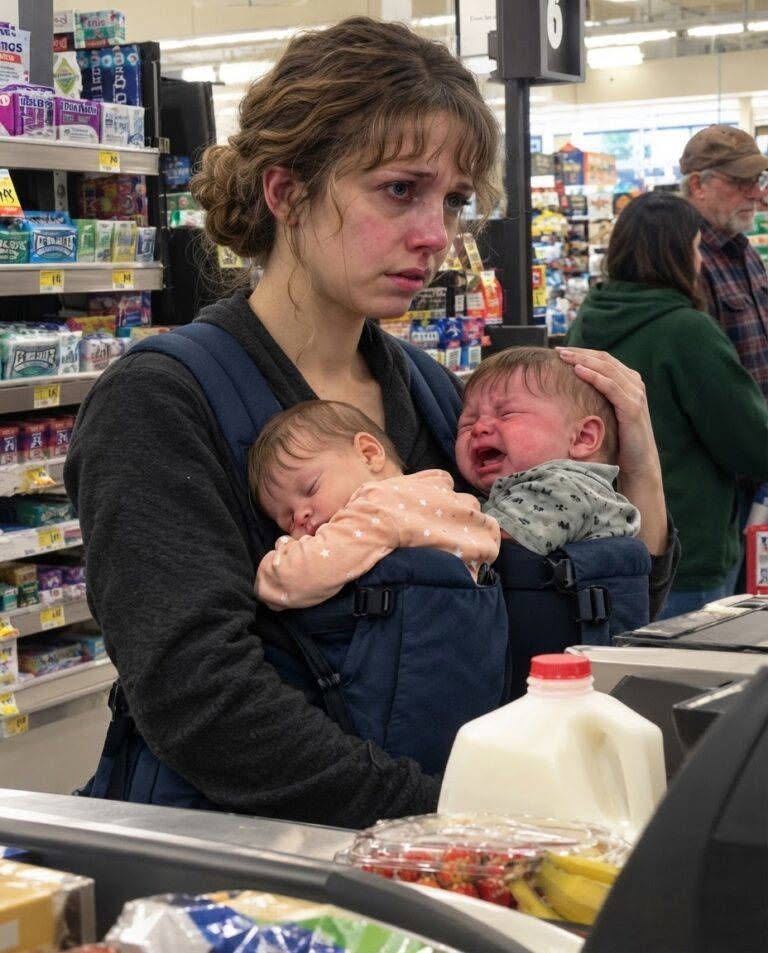
He shoved the money into his pocket and left.
Near the entrance, he paused and looked toward the parking lot.
Then he shook his head and continued outside.
The rest of my shift passed in a blur.
Coupons.
Customers.
A teenager presenting an obviously fake identification card.
A broken jar of pickles that left the store smelling like vinegar.
But I couldn’t forget the young woman’s expression when she saw Dad’s picture.
Just before closing, Mike came over to count my cash drawer.
“Lori says you bought something for a customer,” he remarked.
“Only a few dollars.”
He grunted.
“You know employees aren’t supposed to do that.”
“I know.”
He continued counting.
Then he snapped a rubber band around a stack of bills.
“Go home, Hale. You look exhausted.”
By the time I left, my banana had turned almost black.
I threw it away.
When I arrived home, Mom was waiting at the kitchen table with chamomile tea and a crossword puzzle.
She always waited up, regardless of how often I told her not to.
“There’s potato soup on the stove,” she said.
“Thanks, Mom.”
I filled a bowl and sat across from her.
After a few spoonfuls, I realized I was starving.
“Long day?” she asked.
“Very.”
She studied me.
“Something happened.”
“How do you always know?”
“Because I’m your mother. Tell me.”
So I told her.
About the woman.
The twins.
The declined payment.
The eight dollars and forty-two cents.
I didn’t mention my bank balance, but my mother knew enough about our finances to understand what those dollars meant.
When I finished, she remained quiet.
Then she smiled sadly.
“Your father used to do things like that constantly.”
“I know.”
“No, sweetheart. I mean constantly.”
She leaned back.
“We’d be worried about the mortgage, and he’d come home telling me he’d bought gasoline for someone stranded at a truck stop.”
She shook her head.
“One December, he gave away his winter coat to a young hitchhiker outside Pittsburgh.”
“I never heard that story.”
“I was furious. He came home freezing. I told him he couldn’t possibly rescue every stranger he met.”
She looked at me.
“Do you know what he said?”
I answered quietly.
“You can’t make the whole world right, but you can make the next ten minutes better for somebody.”
Mom’s eyes filled.
“He told you that too?”
“All the time.”
She reached for her pencil.
“That stubborn man.”
I smiled.
“I know.”
“I miss him,” she whispered.
“Me too.”
I went to bed close to midnight.
But sleep wouldn’t come.
I stared at the stain on my ceiling, remembering how that woman had reacted to the picture.
It hadn’t looked like ordinary curiosity.
It looked like recognition.
But how could she possibly have known him?
Dad had been dead for twenty-two years.
She appeared to be in her mid-thirties.
She would have been a teenager when he died.
And she wasn’t from Millbrook.
I would have recognized her.
Maybe she’d simply been exhausted.
Maybe I’d imagined the entire thing.
Eventually, my thoughts drifted to the night Dad died.
The telephone ringing at two in the morning.
My mother’s voice changing when she answered.
The horrible silence afterward.
I remembered the funeral.
The truck drivers who traveled from several states to pay their respects.
Grown men standing quietly at the back of the church, tears rolling down their faces.
Then I remembered the watch.
After the accident, the police returned Dad’s belongings in a clear plastic bag.
His wallet.
Wedding ring.
Keys.
Some sunflower seeds.
A crumpled diner receipt.
But his watch was missing.
Mom called the authorities repeatedly.
She contacted the hospital.
The towing company.
Anyone who might know where it had gone.
Nobody had seen it.
We assumed it had been thrown from the vehicle during the accident and buried somewhere along Route 9.
That spring, after the snow melted, Mom took me to the roadside.
We searched the ditch for hours.
We never found it.
She rarely talked about the watch afterward.
But I knew how much it hurt her.
She had saved so carefully to buy it.
And she’d engraved a message on the back.
Dad had worn it every day.
Then, suddenly, it was gone.
I finally fell asleep imagining that watch buried beneath damp leaves, somewhere beside the road where we’d lost him.
The next morning, I arrived at work four minutes late.
I’d barely entered through the employee door when Lori hurried toward me.
Lori never hurried.
So the sight of her practically rushing across the store immediately worried me.
“Rachel,” she said. “Mike wants you in his office.”
“Why?”
“Right now. He asked me to cover your register.”
My stomach tightened.
“Lori, am I in trouble?”
She hesitated.
Then she squeezed my arm.
“Just go, sweetheart.”
I walked toward the manager’s office with a thousand possibilities racing through my mind.
Maybe someone had complained about yesterday.
Maybe paying for that woman’s diapers had violated company policy badly enough to get me fired.
Maybe my cash drawer had been short.
Maybe corporate was looking for an excuse to reduce staff.
I couldn’t lose my job.
Not with Mom’s medication and the electric bill.
Not with my car barely running.
By the time I reached Mike’s office, my palms were damp.
I knocked.
“Come in.”
Mike was sitting behind his desk with a plain white envelope under his folded hands.
His reading glasses rested on his forehead.
He didn’t look angry.
He looked unsettled.
“Close the door, Hale.”
I obeyed.
“Sit down.”
I stayed standing.
“Mike, if this is about the woman yesterday, I know I shouldn’t have done it. But she had two babies, and she couldn’t afford the diapers, and I used my own card—”
“Hale.”
“I didn’t take anything from the register, so I thought—”
“Rachel.”
I stopped.
Mike almost never used my first name.
He studied me carefully.
“Yesterday, you helped a young woman with twin boys, didn’t you?”
I nodded.
“She couldn’t pay for everything, and you covered the difference?”
“Yes.”
He glanced at the envelope.
Then held it out.
“She returned after your shift ended.”
I stared.
“She came back?”
“Just after ten. She asked me to give you this.”
On the front, written neatly, were the words:
**For Rachel, the cashier at register three. Please.**
The final word had been underlined twice.
I accepted the envelope.
It felt unexpectedly heavy.
“She asked about you,” Mike continued.
“What about me?”
“First, she wanted your full name. I told her I couldn’t give out employees’ personal information.”
He paused.