The Jensen boys purchased energy drinks and beef jerky.
Emma Tate’s mother came through with supplies for her daughter’s seventh birthday and showed me a photograph of a homemade unicorn cake.
One side was noticeably higher than the other.
“It’s beautiful,” I told her.
“It’s a complete mess,” she laughed.
“Then it’s a beautiful mess.”
By lunchtime, I’d eaten a few crackers.
By three, my feet hurt.
By five, the after-work crowd began filling the store.
Everyone seemed tired.
The lines grew longer.
People became impatient.
Then, at 6:40 that evening, a young woman came through the entrance.
I noticed her immediately.
Strangers stand out in Millbrook.
She looked exhausted.
Her long braids were secured with a simple elastic band. She wore an oversized gray sweatshirt and jeans faded almost white around the knees.
But what caught my attention was the black infant carrier strapped across her chest.
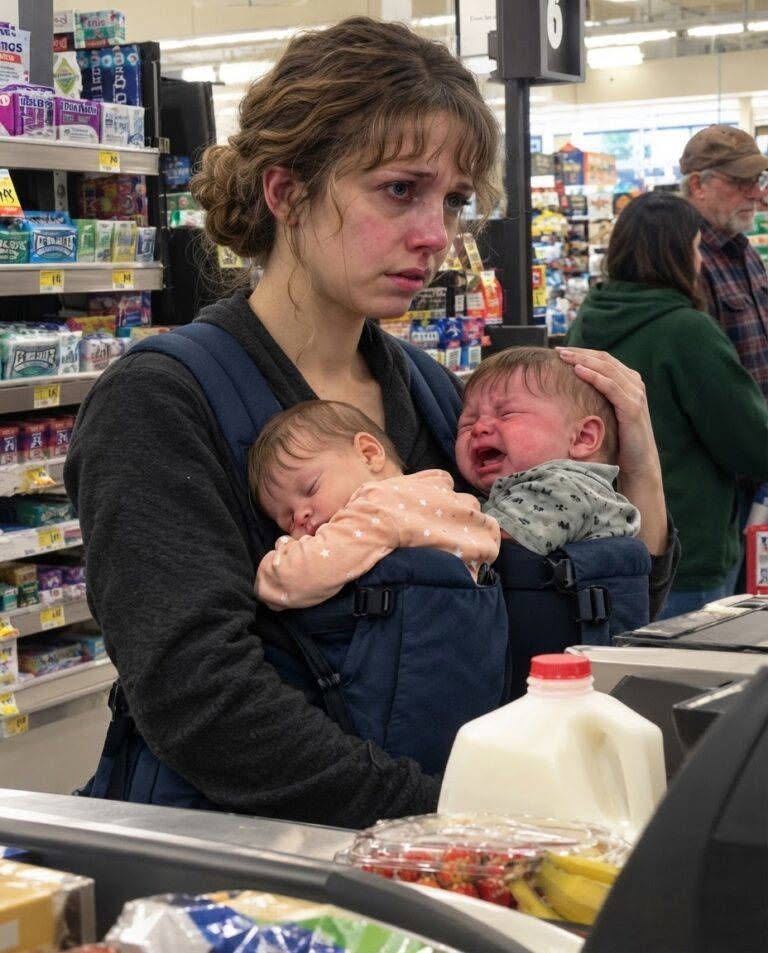
Inside were two babies.
Twins.
They appeared about four or five months old.
One slept peacefully with his mouth open and a tiny hand resting against his mother’s shirt.
The other was crying as if his entire world had fallen apart.
The woman gently bounced as she walked through the aisles.
“I know, sweetheart. I know. Mama’s almost finished.”
She didn’t have a shopping cart.
She carried her few purchases in her hands.
When she joined my checkout line, four people were already waiting ahead of her.
I noticed her repeatedly examining the products she was holding.
Then she checked her phone.
Then looked at the products again.
Her lips moved as she silently calculated.
I knew that expression.
I’d worn it myself that very morning.
Directly behind her stood Dale Pruitt, who owned a small auto repair shop near the edge of town.
Dale wasn’t a cruel man.
But patience had never been one of his strengths.
He held a case of beer and a frozen pizza, and he looked increasingly annoyed by the baby’s cries.
Eventually, the woman reached my register.
“Good evening,” I said warmly. “Did you find everything you needed?”
“Yes, thank you.”
She placed three items on the conveyor belt.
A gallon of milk.
A container of baby formula.
And a package of size-two diapers.
The cheapest diapers we sold.
That was everything.
I glanced toward her infants.
“They’re adorable. Are they twins?”
She managed a tired smile.
“Yes. This noisy one is Noah. And the sleepy one is Eli.”
“Hello, Noah. Sounds like you’re having quite a day.”
Noah responded with another impressive scream.
His mother winced, then laughed weakly.
“He’s hungry, needs changing, and isn’t particularly happy with me.”
“Well, he’s certainly got powerful lungs.”
“Just like his father.”
Something changed in her expression when she said that.
For a brief moment, her face closed off.
I didn’t ask questions.
I scanned her groceries and gave her the total.
She tapped her bank card.
The terminal beeped.
Then a red message appeared.
**DECLINED.**
“Oh,” she murmured. “That can’t be right. Could I try again?”
“Of course.”
She tried a second time.
Her fingers were shaking.
Another beep.
Another rejection.
Behind her, Dale released an exaggerated sigh.
“You’ve got to be kidding,” he complained. “It’s Friday night.”
Someone farther back called out, “Can’t you open another checkout?”
The woman’s cheeks turned bright red.
She began searching through her diaper bag while rocking Noah.
Eventually, she found a wallet.
Inside were a library card, a folded paper, and a few coins.
She counted the money carefully.
Then she looked down.
“I’m sorry,” she whispered. “Would you mind removing the diapers?”
I glanced at the register.
Without the diapers, she could afford the formula and milk.
With them, she was short eight dollars and forty-two cents.
Such a small amount.
People spend more than that on coffee without thinking twice.
But I’d seen what a few dollars could mean to someone struggling.
I’d watched customers return bread to the shelf.
Seen children put back birthday treats.
And I remembered my own mother quietly setting aside a package of chicken years earlier because she couldn’t afford everything in our cart.
Now this exhausted young mother stood before me, holding two infants, forced to choose between keeping them fed and keeping them dry.
I thought about my sixty-one dollars.
About our electric bill.
About the noise coming from my car.
For a second, I considered all the reasons I should be careful.
Then my hand brushed the corner of my father’s photograph.
And I heard his voice in my memory.
*You can make the next ten minutes better for somebody.*
I reached into my pocket for my own debit card.
“Don’t worry,” I told her. “I’ll cover the difference.”
Her head snapped up.
“What? Oh, no. You really don’t have to.”
But I’d already tapped my card.
The terminal chirped.
**APPROVED.**
The receipt began printing.
The woman’s eyes instantly filled with tears.
She covered her mouth.
“I can’t let you do that. I don’t even know when I could pay you back.”
“You don’t need to,” I assured her. “Please. Take your groceries home and take care of those little boys.”
I placed the diapers into her bag.
For several seconds, she remained motionless.
Behind her, Dale shifted impatiently.
He seemed about to speak.
But when he saw the tears streaming down her cheeks, he looked away.
The woman continued staring at me.
Then her gaze dropped toward the side of my register.
Toward the photograph.
My father’s photograph.
And everything about her changed.
Her face lost its color.
Her hand became still against Noah’s back.
Her mouth opened slightly.
She looked as if she’d recognized someone she believed could not possibly be there.
“Ma’am?” I asked gently. “Are you all right?”
She didn’t answer.
Her eyes stayed fixed on the photograph.
“Is something wrong?”
She blinked several times.
Then looked from the picture to my face, as though searching for a resemblance.
“Is that…”
She stopped.
Before she could finish, Noah began crying even louder.
His brother woke and joined him.
The line behind her was growing.
Another customer complained.
The moment slipped away.
“I’m sorry,” she said quickly. “Thank you. Thank you so much.”
“Of course.”
She collected her groceries and started toward the exit.
Then she turned around.
“You really don’t understand what you’ve done for me.”
Her voice shook.
“Especially today.”
“It’s only a few dollars.”
“No,” she said firmly. “It’s not just a few dollars.”
She thanked me again.
And again.
As she reached the automatic doors, she looked over her shoulder one last time.
Not at me.
At my father’s picture.
Then she disappeared outside.
Dale approached the register without speaking.
I scanned his beer and frozen pizza.
“Thirty-one dollars and sixteen cents.”
He paid with cash.
When I handed him his change, he hesitated.
“That was decent of you,” he muttered.
“She needed help.”
He nodded.
“Yeah. She did.”