Part 1: The Daughter They Called a Regret
My mother had proudly walked both of my sisters down the aisle, treating each wedding as though she were presenting something precious to the world. But on the morning of my own wedding, she stood in the bridal room, looked directly at me in my white dress, and delivered the words she had apparently been waiting years to say.
“I refuse to walk my greatest regret to the altar.”
The entire room went silent.
My fingers tightened around my veil, but I refused to let them see me cry. Behind Mom, my sisters Paige and Lauren exchanged satisfied smiles, clearly enjoying the humiliation.
Paige adjusted the diamond bracelet Mom had helped purchase for her, while Lauren glanced at my reflection.
“Don’t cry, Emma. You’ll ruin the cheap mascara.”
I stared into the mirror and saw a twenty-nine-year-old woman who had spent most of her life being treated as the family mistake. While my sisters received spacious bedrooms, expensive gifts, and birthday vacations to Paris, I had slept in the attic and learned early that asking for equal treatment only made my parents resent me more.
My father stood near the doorway in his gray tuxedo, watching everything with an amused expression.
“Your mother has a right to her feelings. You’ve always been difficult.”
Difficult.
That was their favorite word for me.
I had been difficult when I asked what happened to the college fund my grandmother supposedly left me. I was difficult when I questioned why Grandpa Arthur’s letters suddenly stopped arriving, and apparently I became even more difficult when I chose forensic accounting instead of marrying into wealth and remaining grateful for whatever my parents decided I deserved.
My fiancé, Daniel, stepped forward, anger barely concealed beneath his calm expression. Before he could say anything, I touched his sleeve.
“Don’t. Not yet.”
Mom laughed softly.
“Still dramatic. Even today.”
Then the bridal room door opened.
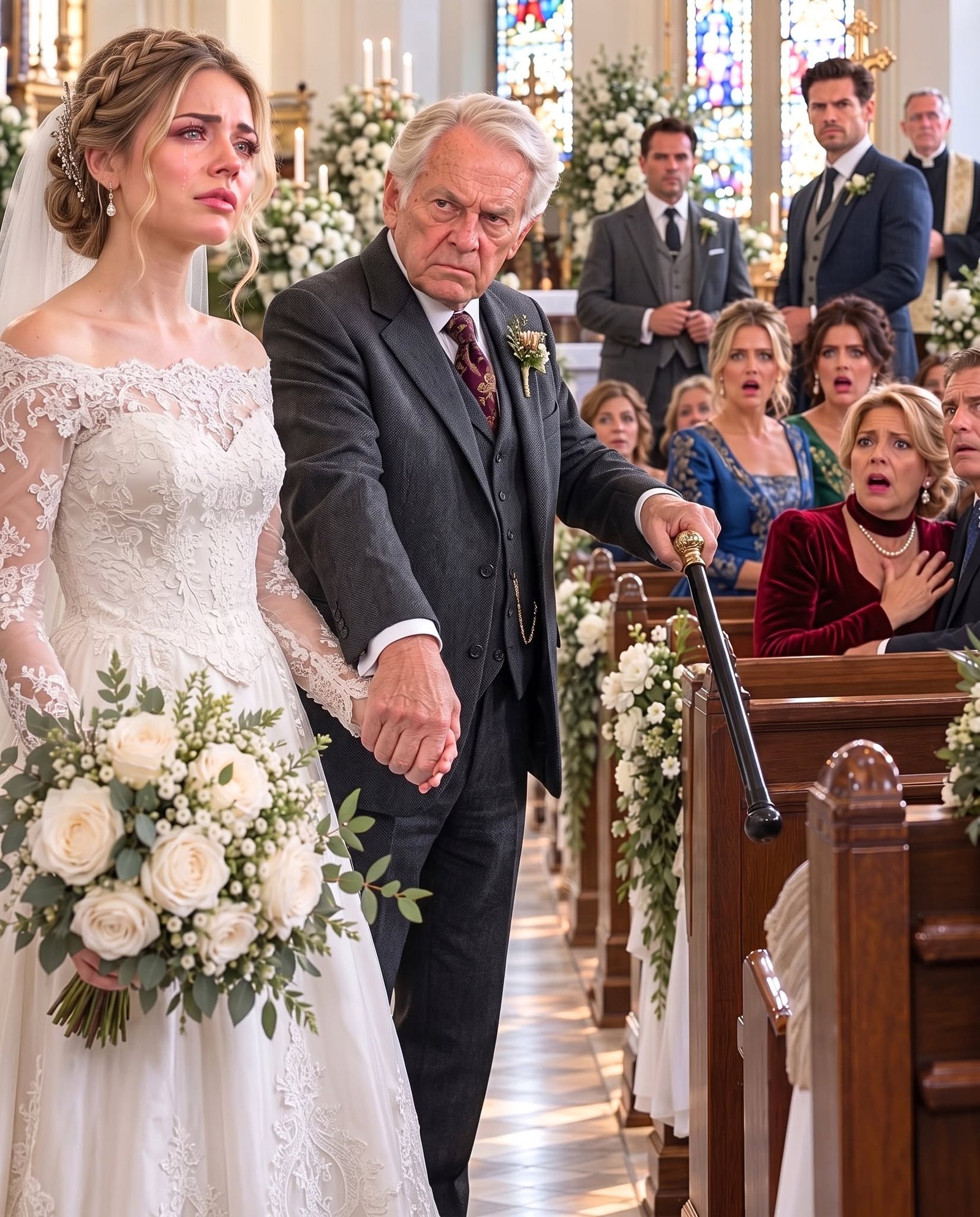
Grandpa Arthur entered with a black cane in one hand. At eighty-one, his white hair was carefully combed and his navy suit was older than either of my sisters’ marriages, but his sharp eyes could still silence a room.
He looked directly at Mom.
“Margaret, you said what?”
Her expression immediately tightened.
“This is family business.”
“I am family.”
Dad stepped toward him.
“Arthur, don’t make a scene.”
Grandpa ignored him and came to me instead. He reached for my hand and held it firmly.
“I’ll walk you.”
My throat tightened.
“Grandpa…”
“You were never a regret, Emma.”
His thumb pressed gently against my palm before he added something that made my mother’s smile disappear.
“You were the only one who came back for the truth.”
Mom’s expression flickered.
Only for a second, but Grandpa and I both noticed.
Outside, the organ began playing. The church was packed with relatives, business partners, neighbors, and donors to my parents’ charity foundation, all waiting to celebrate the supposedly perfect Stone family.
Mom lifted her chin as though nothing could touch her.
She had no idea that for the previous eighteen months, I had been tracing every dollar she and Dad thought had disappeared forever.
The church doors opened.
Grandpa offered me his arm.
And together, we began walking toward the people who had stolen my inheritance.
Part 2: Eight Words That Silenced the Church
Every head in the church turned as Grandpa Arthur and I stepped through the doors. Paige and Lauren stood near the altar in matching champagne dresses, both wearing the same smug expressions they had carried in the bridal room, while Mom sat perfectly upright in the front pew beside Dad.
We had made it halfway down the white runner when Grandpa suddenly stopped.
The organ music faltered.
His hand tightened around mine, and before I could ask what was wrong, he turned toward my mother.
“Tell them whose blood paid for your house.”
Eight words were enough to change the entire room.
A collective gasp moved through the church. Dad’s confident smile vanished, while Mom stared at Grandpa with unmistakable panic.
“Arthur, please.”
He raised his cane and pointed toward her.
“No. She called my granddaughter a regret in the house of God. Now God can hear the rest.”
Mom immediately stood.
“This is not the time.”
From the altar, Daniel answered before I could.
“It became the time when you humiliated her.”
Paige glared at me.
“Emma, stop this.”
I met her eyes.
“I haven’t started.”
Whispers spread through the pews as Dad rose, his face turning red.
“Everyone sit down. Arthur is confused. He’s elderly.”
Grandpa gave a short laugh.
“Elderly, yes. Confused, no.”
He reached inside his jacket and removed a sealed envelope. His hands were perfectly steady, and the moment Mom saw it, the remaining color disappeared from her face.
That reaction told the room more than any accusation could.
Grandpa handed the envelope to Daniel’s best man, Marcus Reed, who also happened to be my attorney. Marcus opened it and removed notarized bank statements, trust documents, and a handwritten letter protected inside a plastic sleeve.
My sisters finally stopped smiling.
Marcus addressed the room calmly.
“These records show that Margaret and Thomas Stone diverted funds from a wrongful death settlement and an education trust belonging to Emma Stone. The money was transferred through the Stone Family Foundation over a seventeen-year period.”
“That’s a lie!” Dad snapped.
I looked at him.
“No. It’s arithmetic.”
Phones began appearing throughout the church as relatives and guests realized they were witnessing something far bigger than a family argument.
Mom gripped the pew.
“Emma, you don’t understand. We had expenses. Your sisters had needs.”
“My sisters had destination weddings. Paige got a condo, and Dad secretly financed Lauren’s boutique. Meanwhile, I took out student loans because you told me the money Grandma left for my education was gone.”
Paige stared at me.
“You’re blaming us?”
“I’m naming facts.”
Then Grandpa turned toward the guests, and his expression changed.
“Her grandmother died because Margaret delayed calling an ambulance after they argued about Emma’s trust. She fell and was bleeding, but Margaret called Thomas first. Not 911.”
Someone in the congregation cried out.
Mom shook her head rapidly.
“It wasn’t like that.”
Grandpa’s voice cracked for the first time.
“I heard the voicemail, Margaret. So did Emma.”
Dad stepped backward.
That was the secret neither of them knew I had uncovered.
Eighteen months earlier, while examining old financial and insurance records, I had found Grandma’s final voicemail buried inside an archived file.
Her weak voice had said:
“Margaret took Emma’s papers. Arthur, help me. I’m hurt.”
Until that moment, my investigation had been about stolen money.
Standing in the church, I understood why Mom looked truly terrified.
She hadn’t merely stolen my inheritance.
She had spent years hiding what happened to the woman who tried to protect it.
Part 3: The Evidence They Couldn’t Bury
Mom suddenly rushed into the aisle when she noticed one of my cousins recording everything on his phone.
“Turn that off! This is private!”
I remained beside Grandpa, watching the composure she had maintained for years finally begin to crack.
“No. Theft is private until prosecutors get involved.”
Dad pointed at me, his face twisted with anger.
“You ungrateful little brat. After everything we gave you?”
I looked around the church at the flowers Daniel and I had paid for, the guests my parents desperately wanted to impress, and the altar where I was supposed to begin a new life. For once, none of their accusations made me feel guilty.
“You gave me a childhood of leftovers. Grandpa gave me evidence. Grandma gave me legal standing. And you gave me motive.”
Marcus removed another folder and handed it to Dad.
“Thomas Stone, you were served this morning at 9:12 a.m. The civil suit has been filed. A criminal complaint has also been submitted to the district attorney’s financial crimes unit.”
Dad stared down at the documents. His hands began trembling as he read the first page.
Mom stepped backward toward him.
“Thomas, fix this.”
For the first time in my life, my father didn’t look like the powerful man who could make every problem disappear with money or influence.
He looked trapped.
“There’s more,” I said.
Lauren rolled her eyes despite the panic spreading across her face.
“Of course there is. You always need attention.”
I almost smiled.
“The Stone Family Foundation board reviewed my audit last night. Mom and Dad were removed from their positions.”
Several people in the pews immediately began whispering. Many of them were donors who had contributed large amounts to the foundation because they trusted my parents.
“Every donor here will receive the findings. Next month’s gala has been canceled, and temporary restraining orders have been placed on the house, the lake property, and both business accounts while the stolen trust assets are traced.”
Paige’s expression suddenly changed.
“My condo…”
Marcus answered before I could.
“Purchased with traceable funds. Yes.”
Her face collapsed.
For years, Paige and Lauren had treated my financial struggles as proof that I simply wasn’t as successful as they were. Neither had ever questioned why their expensive lifestyles seemed effortless while I was buried beneath student loans that never should have existed.
Dad suddenly turned toward Mom.
“You said the transfers were clean.”
Mom struck him in the chest with the envelope.
“You signed them!”
The church erupted into shocked conversation.
Their alliance was disintegrating in front of the same people they had spent decades trying to impress. Dad blamed Mom, Mom blamed Dad, and my sisters finally realized that the wealth they had treated as permanent might never have belonged to our family at all.
Grandpa gently squeezed my hand.
“Walk, sweetheart.”
So I did.
We continued down the aisle while my parents argued behind us. I walked past Mom’s panic, Dad’s ruined confidence, and my sisters staring at one another as though someone had suddenly removed the floor beneath them.
When I finally reached the altar, Daniel took my free hand.
His eyes were wet, but he smiled.
“Still want to marry me after all that?”
I laughed through the tears I had refused to shed for my mother.
“Only if you promise our children never have to earn love like a paycheck.”
“I promise.”
Then, behind us, the church doors opened again.
Two uniformed officers stepped inside.
And this time, they weren’t there for the wedding.

Part 4: The Vows They Couldn’t Destroy
The two officers remained quietly near the back of the church instead of interrupting the ceremony. They had already been briefed about the financial complaint, but they waited while Daniel and I stood before the pastor, giving us the dignity of finishing what my family had tried so hard to ruin.
Behind me, Mom and Dad had finally stopped arguing. Paige sat frozen beside Lauren, both of them staring at Marcus’s documents as the consequences of seventeen years of stolen money began settling over them.
I turned toward Daniel.
Everything that had happened that morning could have consumed our wedding, but when he took both of my hands, the noise behind us seemed to disappear. This was the reason I had waited to expose my parents until I knew the evidence was complete. I wasn’t destroying my wedding day.
I was making sure they could never control another day of my life.
The pastor continued the ceremony, and Daniel repeated his vows without taking his eyes from mine. When my turn came, my voice trembled at first, but then I glanced toward Grandpa Arthur.
He stood near the altar with his cane tucked beneath one arm, watching me with tears in his eyes.
For most of my childhood, I had believed there was something fundamentally wrong with me. Paige and Lauren received praise effortlessly, while affection toward me always seemed conditional. If I stayed quiet, achieved enough, and asked fewer questions, perhaps my parents would finally treat me as though I belonged.
Standing beside Daniel, I understood how wrong that lesson had been.
When the pastor finally pronounced us husband and wife, Daniel kissed me and the congregation rose. Not everyone applauded. Some guests cried, others whispered among themselves, and several donors were already speaking quietly with Marcus.
Grandpa Arthur was the first person to clap.
He stood proudly with his cane beneath his arm, looking like a man who had finally set down a burden he had carried for twenty years.
Only after our vows were complete did the officers move forward.
It was probably the kindest thing anyone did for my mother that day.
The legal consequences unfolded over the following months. My parents’ house, which had been supported partly by money traced to my inheritance, had to be sold as authorities and attorneys worked to recover the diverted assets.
Dad eventually accepted a plea agreement for fraud. His confidence disappeared quickly once the bank records, foundation transfers, and trust documents were placed beside his sworn statements.
Mom fought much longer.
She blamed Dad, Grandpa, me, the foundation board, and even Marcus. She insisted that every decision had been necessary for the family and continued claiming that I misunderstood what had happened to Grandma.
Then Grandma’s voicemail was played in court.
“Margaret took Emma’s papers. Arthur, help me. I’m hurt.”
After that, Mom’s version of events became much harder to defend.
Paige’s condo was seized because investigators traced the purchase funds back to assets diverted from my trust. Lauren’s boutique, which Dad had secretly financed using the same network of accounts, closed before Christmas.
The lifestyle my sisters had once used to measure their superiority disappeared almost overnight.
But none of those losses mattered to me as much as what happened the following spring.
Grandpa Arthur packed his belongings and moved into the guesthouse behind the home Daniel and I had begun building together.
And with him came the last pieces of Grandma’s story that my parents had spent years trying to bury.
Part 5: When Family Finally Felt Clean
Grandpa moved into our guesthouse that spring, bringing only a few boxes, his old books, and the black cane he had carried down the aisle on my wedding day. After decades of family secrets and arguments, living near him felt unexpectedly peaceful.
Every Sunday morning, the two of us worked in the garden together.
We planted roses for Grandma.
Grandpa told me stories about her that I had either forgotten or never been allowed to hear. He described how fiercely she had protected the education trust created for me and how suspicious she became when financial statements stopped matching what my parents claimed.
The more I learned, the more I understood why Margaret had tried so hard to keep Grandpa and me apart.
For years, I believed his letters had simply stopped coming. In reality, my parents had intercepted enough communication to convince each of us that the other had slowly withdrawn.
Grandma had never withdrawn.
Neither had Grandpa.
My parents had simply discovered that isolation made their lies easier to maintain.
The financial case eventually recovered a substantial portion of what had been taken from my trust. Some assets were impossible to recover completely after seventeen years of transfers and spending, but by then, getting every dollar back was no longer what mattered most to me.
I had the truth.
More importantly, I finally understood that the way my parents treated me had never been proof that I deserved less.
One morning, I stood beside the garden gate watching Daniel paint the nursery pale yellow. We were preparing for another chapter of our lives, one that I intended to build very differently from the home in which I had grown up.
Grandpa approached slowly and stopped beside me.
“Regret anything?”
I smiled at the word.
Once, hearing it would have taken me straight back to the bridal room, standing in my wedding dress while my mother announced that I was her greatest mistake.
Now it belonged to her, not me.
I reached for the small gold locket resting against my chest. It had belonged to Grandma and had finally been returned to me by court order after being discovered among property connected to the case.
“No,” I said. “Not anymore.”
Grandpa nodded and looked toward the roses.
My parents had spent years building the image of a perfect family. They had the large house, the charity foundation, successful daughters, expensive weddings, and photographs carefully designed to convince everyone that the Stone name represented generosity and respectability.
But behind that image, love had always come with conditions.
Paige and Lauren learned that money meant approval. Dad learned that silence could protect him. Mom learned that controlling the truth allowed her to control everyone around her.
I had learned something different.
Family wasn’t the person who paid for the most expensive wedding or handed you a luxury apartment. It wasn’t someone who demanded gratitude while secretly taking what belonged to you.
Family was Grandpa offering me his arm when my mother refused.
It was Daniel standing at the altar while my entire childhood collapsed behind me and still asking whether I wanted to build a future with him.
It was Grandma protecting me even when she knew confronting my mother could cost her everything.
For most of my life, I had been desperate to prove I deserved a place in the Stone family.
By the time the roses began blooming that spring, I no longer wanted one.
I had something better.
I had Grandpa nearby, Daniel beside me, Grandma’s locket against my heart, and a child on the way who would never have to perform for affection.
For the first time in my life, the word family no longer felt like a debt I was expected to repay.
It finally felt clean.