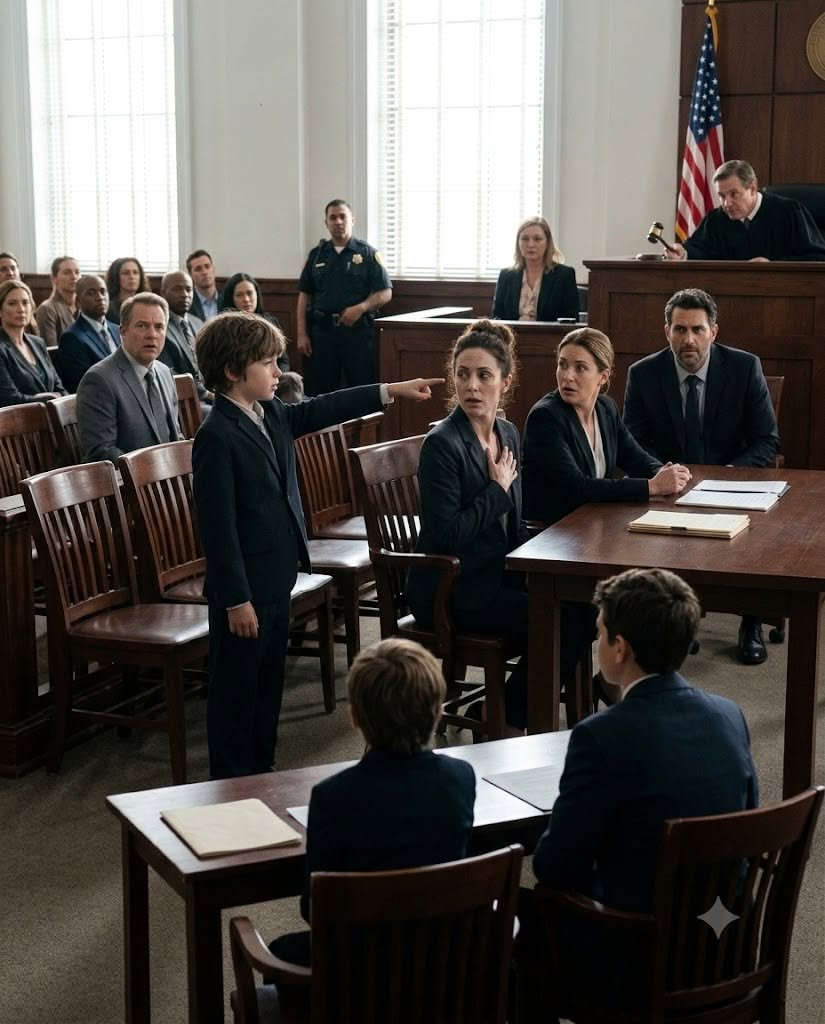
My nine-year-old son sat silently in the back row of the courtroom while my own husband did everything he could to destroy me.
Then, just as the judge was preparing to move forward with the verdict, my little boy stood up.
His voice was soft, almost trembling, but every word carried through the courtroom.
“Your Honor, I know who framed my mom. The person is in this courtroom.”

For the first time in six years, everyone stopped talking about me as if I were a criminal and started listening.
But to understand how we ended up in that courtroom, you need to understand what my husband had done to me.
His name was Daniel.
We hadn’t always been enemies. Once, we had been partners in every sense of the word. We built our company from nothing, working late into the night at our kitchen table while our children slept upstairs. We had no fancy office, no wealthy investors, and no guarantee that our little business would survive.
There were nights when we argued over bills and mornings when we celebrated our smallest victories with cheap coffee and tired smiles.
I believed we were building something that would belong to our family for generations.
I never imagined that one day, the same man who had held my hand through those difficult years would sit in a courtroom and swear that I was a thief.
But that’s exactly what happened.
When the company’s accounts showed suspicious transfers and missing funds, Daniel was the first person to accuse me.
At first, I thought he was simply confused. I assumed that once we reviewed the records together, we’d find an accounting error or a misunderstanding that could be corrected.
Instead, he hired lawyers.
Then he filed a formal complaint.
And before I could understand what was happening, I was facing criminal charges for allegedly stealing from the very company I had helped build.
The evidence seemed overwhelming. Documents carried my name. Financial records appeared to show money moving through accounts I supposedly controlled. There were signatures that looked like mine and transactions I couldn’t explain.
I knew I hadn’t done any of it.
Someone had taken my identity, my access, and my trust and turned them into weapons against me.
But knowing the truth and proving it were two very different things.
Daniel made sure everyone heard his version first.
“She forged my signature,” he told the investigators.
“She emptied the accounts.”
He said it with such certainty that people began looking at me differently. Friends who had once visited our home stopped answering my calls. Business associates avoided me. Even people who had known me for years began whispering behind my back.
I kept trying to explain.
“I didn’t take anything,” I told my lawyers. “I would never steal from our company. We built it together.”
But every time I spoke, another piece of evidence seemed to contradict me.
The worst part wasn’t the money or the company. It was watching my family slowly disappear from my life.
My daughter stopped speaking to me.
At first, I called her every day. I left messages explaining that I loved her and that the accusations weren’t true. I reminded her of the life we’d shared, of birthdays, family vacations, and all the ordinary moments that had once made us feel inseparable.
She never called back.
Eventually, I stopped leaving messages because I couldn’t bear the sound of my own voice begging my child to believe me.
My son, Noah, was only three when everything began to fall apart. He was too young to understand court documents or financial records, too young to know why his parents were suddenly on opposite sides of a war neither of them had ever explained to him.
As the years passed, I saw him less and less.
Six years is a long time in a child’s life.
By the time the case reached its final stage, Noah was nine. I had missed birthdays, school milestones, and countless little moments I could never recover. I didn’t know what he remembered about me or what Daniel had told him.
I only knew that I had lost almost everything.
My reputation was gone. My marriage had collapsed. My company was no longer mine in any meaningful sense. I had spent years defending myself against accusations that seemed designed to follow me everywhere.
And now, at last, the day of the verdict had arrived.
I sat at the defense table with my hands folded tightly in my lap. My lawyer had warned me not to expect a miracle. The prosecution had presented its case with confidence, and Daniel’s testimony had done enormous damage.
He had taken the stand and spoken about me as though I were a stranger he’d discovered committing a terrible crime.
There had been no hesitation in his voice.
No sadness.
No trace of the man who once promised that we would face every hardship together.
“She had access to everything,” he told the jury. “She knew the accounts, the passwords, and the company’s internal systems. I trusted her, and she used that trust to steal from us.”
I stared at him, struggling to recognize the person standing before me.
When our eyes met, he looked away.
That small gesture hurt more than I expected. Some part of me had still hoped to see a flicker of guilt, a moment of hesitation that would tell me he remembered the woman I had been before he turned my life into a courtroom battle.
There was nothing.
By that morning, I had begun preparing myself for the possibility that I would lose the rest of my life to a lie.
I was thinking about the things I might never do again when the courtroom doors opened.
I barely looked up at first.
Then I saw a familiar blue backpack.
Noah.
He stood in the doorway, looking taller and thinner than I remembered. His face had changed in six years, but I recognized the way he held his shoulders when he was nervous. I recognized the backpack, too. I had bought it for him before everything fell apart.
For a moment, I couldn’t breathe.
I hadn’t known he was coming.
He walked down the aisle slowly, his eyes fixed on me. When he reached my table, he stopped.
“Mom,” he whispered, “I know who set you up.”

I stared at him.
“What did you just say?”
His chin trembled, but he didn’t look away.
“I saw them in your office,” he said. “They were going through your things. They found the notebook where you kept your passwords.”
The room seemed to tilt around me.
My old office.
The notebook.
The passwords.
I had kept a small notebook in a locked drawer in my office during the company’s early years. It contained reminders and access details from a time when we were too small to have a dedicated technology department. I had stopped using it long before the missing money appeared.
I had never understood how anyone could have accessed the accounts without leaving a trail.
Now my son was telling me that someone had gone through my belongings.
Daniel shot to his feet.
“Your Honor, this is outrageous!” he snapped. “This is manipulation. A frightened child trying to save his mother.”
His reaction was so immediate, so furious, that several people turned to look at him.
Noah flinched, but he remained standing.
Whispers spread across the courtroom.
The judge struck the bench with his gavel.
“Order!”
The room fell silent.
The judge looked at Noah with a measured expression.
“Young man, these are very serious accusations. Do you understand that? Are you prepared to tell this court exactly what you saw?”
Noah swallowed hard.
Then he straightened his small shoulders.
“Yes, Your Honor.”
His eyes moved across the courtroom.
Past the jury.
Past the lawyers.
Past the people sitting behind us.
Then he slowly raised his hand and pointed.
Daniel’s face drained of color.
Because Noah wasn’t pointing at his father.
He was pointing at someone sitting just a few seats behind the prosecution table.
Someone who had been present throughout the trial.
Someone who had listened quietly while Daniel accused me of stealing millions from the company we had built together.
The courtroom went completely silent.
“Who is that person?” the judge asked.
Noah took a shaky breath.
“It’s the person who went into Mom’s office with Dad.”
Daniel immediately began speaking over him.
“This is ridiculous! He’s a child! He doesn’t understand what he saw!”
But the judge raised a hand.
“Mr. Daniel, you will remain silent until I allow you to speak.”
For the first time that morning, Daniel obeyed.
The judge turned back to Noah.
“Tell me what happened.”
Noah looked at me, and I tried to give him the smallest reassuring smile I could manage.
He took another breath.
“It was late. I couldn’t sleep, so I went downstairs looking for Dad. I heard voices coming from Mom’s office. The door was open a little, and I saw Dad inside with that man.”
He pointed again.
“They were opening drawers and looking through Mom’s papers. Dad took a notebook out of a drawer. The man told him they needed the passwords, and Dad said they would be able to make everything look like Mom had done it.”
A murmur swept through the room.
Daniel shook his head violently.
“No! That’s a lie!”
Noah’s eyes filled with tears.
“I remember because Dad told me not to tell Mom. He said it was grown-up business and that I would get everyone in trouble if I talked about it.”
The judge leaned forward.
“Did you tell anyone what you saw at the time?”
Noah shook his head.
“I was scared. Dad said Mom was going to leave us and that she was a bad person. I thought maybe I had misunderstood.”
He wiped his face with his sleeve.
“But when I heard everyone saying Mom was going to prison, I knew I couldn’t keep quiet anymore.”
I pressed my hand over my mouth.
For six years, I had wondered how my own child would remember me. I had imagined him believing the worst, growing up convinced that his mother had betrayed his family.
Instead, he had carried a memory he didn’t fully understand, waiting until he was brave enough to speak.
The judge ordered a recess and directed the attorneys to address the allegations. The man Noah had identified was asked to remain in the courthouse while the court considered what to do next.
Daniel’s confidence had vanished.
He kept looking toward the doors, then toward his lawyer, whispering urgently. The man Noah had accused sat rigidly in his chair, his face unreadable.
My lawyer leaned toward me.
“Don’t say anything yet,” she whispered. “If what Noah says can be corroborated, it could change everything.”
For the first time in years, I felt something I had almost forgotten.
Hope.
But hope wasn’t proof.
Noah’s testimony had raised serious questions, and the court would need more than a child’s recollection to determine what had happened. My lawyer requested that the relevant records be preserved and that the allegations be investigated before the case proceeded.
The judge agreed that the claims could not simply be ignored. The court arranged for Noah’s account to be handled carefully, with appropriate safeguards, and directed that the matter be referred for further investigation.
Over the following days, investigators began examining the company’s financial records again.
This time, they weren’t looking only at the accounts that appeared to implicate me. They were looking at who had accessed them, when the passwords had changed, and whether the documents presented at trial told the complete story.
The first significant discovery came from the company’s old security system.
Although much of the footage had been overwritten, a backup had survived on an archived drive. It showed two people entering my office after hours during the period when the suspicious transactions began.
One was Daniel.
The other was the man Noah had identified.
Their faces were visible.

So were their movements. They opened drawers, removed files, and remained inside the office long after everyone else had left.
The footage alone didn’t establish every detail of the alleged scheme, but it gave investigators a reason to look much more closely at the evidence.
Then came the digital records.
A review of the company’s access logs revealed activity connected to the disputed accounts at times when I had been nowhere near the office. Some of the records had been altered, and several transfers had passed through access points associated with credentials that were supposed to have been under my control.
Investigators also discovered messages that raised questions about the way the financial records had been assembled for the prosecution.
The more they examined the evidence, the less convincing the original story became.
My lawyer explained that the new findings could support a challenge to the case against me. Nothing would be resolved overnight, and I would still have to face the legal process. But the evidence that had once seemed impossible to overcome was finally being examined from another angle.
Then, one afternoon, my lawyer called.
“We’ve found something else,” she said.
I gripped the phone.
“What?”
“A message exchange between Daniel and the other man. It appears they were discussing how to handle the missing funds before the accusations against you were made.”
I closed my eyes.
For six years, I had begged people to listen to me. I had repeated the same words until they felt meaningless.
I didn’t take anything.
Now, for the first time, the evidence was beginning to speak for itself.
The case against me came under renewed scrutiny. My legal team challenged the reliability of the financial records and raised the possibility that evidence had been manipulated. The court proceedings were no longer moving forward as Daniel had expected, and investigators continued examining the conduct of everyone involved.
Meanwhile, my relationship with Noah began to change.
The first time we were allowed to sit together without the pressure of the courtroom, he barely spoke. He sat beside me, twisting the strap of his blue backpack between his fingers.
“Are you mad at me?” he finally asked.
My heart broke.
“Mad at you? Noah, why would I ever be mad at you?”
“Because I didn’t tell anyone sooner.”
I reached for his hands.
“You were a little boy,” I told him. “You were scared, and you didn’t know what to do. None of this was your fault.”
He looked down.
“I thought if I told the truth, Dad would hate me.”
I pulled him into my arms.
“You were brave enough to tell the truth when it mattered. That’s what I want you to remember.”
He began to cry, and I held him as tightly as I could.
I had lost six years of being his mother in the way I had always wanted to be. I couldn’t get those years back. I couldn’t erase the birthdays I had missed or the nights he had gone to sleep believing things he was too young to understand.
But I could be there now.
And I could make sure he knew he had never been responsible for saving me.
That burden had never belonged to him.
As the investigation continued, Daniel’s version of events became increasingly difficult to defend. His earlier testimony was examined alongside the recovered footage, the digital records, and the newly discovered communications. The man Noah had identified was also questioned about his role in the company’s affairs.
The truth did not emerge in one dramatic confession. There were interviews, document reviews, legal arguments, and long stretches of uncertainty. But each new finding made it harder to sustain the accusation that I had stolen from the company.
Eventually, the legal proceedings against me were reconsidered in light of the new evidence, and the case that had consumed six years of my life began to unravel.
I wasn’t suddenly healed.
I still had to rebuild my reputation, deal with the damage to my finances, and come to terms with the betrayal of the person I had once trusted most. My daughter remained distant, struggling to understand how the family she thought she knew could have been built on so many lies.
I didn’t demand that she believe me immediately.
I knew what it felt like to be shown a story so convincing that the truth seemed impossible. If she needed time, I would give it to her.
Daniel, meanwhile, could no longer rely on the authority he had once carried into every room. The allegations surrounding the company’s finances and the evidence that had emerged were now matters for the appropriate authorities and courts to address.
For years, he had counted on everyone believing him.
He had counted on my isolation, my exhaustion, and the assumption that a woman accused of a crime must have done something to deserve it.
Most of all, he had counted on a little boy staying silent.
He had been wrong.
Months later, I stood outside the courthouse with Noah beside me. He wore the same blue backpack, its straps now slightly frayed from years of use.
The morning air was cool, and sunlight fell across the steps where I had once stood feeling as though my entire life had been taken from me.
Noah slipped his hand into mine.
“Mom,” he asked, “are things going to be okay now?”
I looked at him.
I wanted to promise that everything would return to the way it had been before. I wanted to tell him that the lost years would come back, that our family would be repaired, and that no one would ever hurt us again.
But I had learned that promises could be fragile.
So I gave him the truth.
“I don’t know if everything will be okay right away,” I said. “But we’re not going to face it alone anymore.”
He nodded and squeezed my hand.
Then he asked the question that had haunted me for six years.
“Do you think people will know you didn’t do it?”
I knelt in front of him.
“Some people may take time to understand. Some may never admit they were wrong. But we know the truth, Noah. And now, we’re finally able to prove it.”
He leaned forward and hugged me.
For the first time in years, I didn’t feel as though I was standing at the edge of a life that had already been decided for me.
I was standing at the beginning of a new one.
Daniel had believed he could destroy me by turning my own family against me. He had believed that a carefully constructed lie, repeated often enough, would become the only version of the truth anyone was willing to hear.
But he had forgotten one thing.
My son had seen something no one else knew about.
And when the moment came, he chose to speak.
That day in court, Noah hadn’t simply pointed at a man in the room. He had pointed toward the truth that six years of accusations had buried.
And as I walked away from the courthouse with my son’s hand in mine, I finally understood that the most powerful moment of my life hadn’t been the day the evidence began to clear my name.
It had been the moment a nine-year-old boy stood up, faced a room full of adults, and refused to let a lie decide who his mother was.