Caleb had barely touched his father’s guitar since David died. So when he brought it onstage at his school’s Father’s Day assembly, I knew something had changed. What I didn’t expect was that two uniformed strangers would give him a reason to embrace life again.
My name is Jennifer, and my son, Caleb, is 12.
Three years ago, my husband, David, died after a long illness.
People often describe illnesses like his as a “battle.” I understand why. There were appointments, medications, hospital stays, hopeful weeks, and setbacks that made us afraid to hope again.
But near the end, it felt less like fighting and more like watching someone we loved slowly fade away.
Caleb was nine when his father died.
At first, I thought he was coping surprisingly well. Later, I realized he was coping too well.
He cried at the funeral, but afterward, he rarely mentioned David. Whenever someone brought up his dad, Caleb lowered his gaze or changed the subject.
Gradually, he stopped spending time with friends. Some evenings, he took dinner upstairs and ate alone.
His teachers called twice about how withdrawn he’d become.
Caleb used to raise his hand even when he wasn’t sure of an answer. Now he could spend an entire school day silent unless someone spoke directly to him.
I tried everything.
“Do you want to talk about Dad?”
“No.”
“Are you angry?”
“No.”
“Are you sad?”
“I’m fine.”
“Caleb, you know you can tell me anything.”
“I know.”
Then he’d retreat to his bedroom.
“Fine” became his favorite word.
A week before Father’s Day, his school announced an assembly where students could perform songs, recite poems, share stories, or give speeches honoring their fathers and father figures.
Reading the email made my stomach sink.
That evening, I found Caleb eating cereal straight from the box at the kitchen counter.
“About the Father’s Day assembly—”
He stiffened.
“You don’t have to go.”
He looked at me. “Why wouldn’t I?”
“I just thought it might be hard.”
“I want to go.”
“You do?”
“Yes.”
I studied his expression.
“Are you sure?”
“Why wouldn’t I be?”
“Okay. I’m only asking.”
“I’m sure, Mom.”
He said nothing more.
I had no idea he’d registered to perform.
On the morning of the assembly, Caleb came downstairs carrying David’s old acoustic guitar.
He hadn’t touched it in months.
David had taught him his first chords at seven, sitting behind him on the couch and guiding his little fingers into position.
“Ow,” Caleb used to complain.
“Your fingertips have to toughen up,” David would say.
“They’re seven-year-old fingertips.”
“That’s just an excuse.”
They would both laugh.
Seeing that guitar again nearly took my breath away.
“What are you doing with that?” I asked.
Caleb adjusted the shoulder strap.
“I’ll be playing it.”
“At school?”
“Yeah.”
“You didn’t tell me.”
He shrugged. “I’m telling you now.”
The assembly took place in the school gym, where folding chairs filled the floor and handmade paper ties and Father’s Day posters covered the walls.
Children sat beside their dads. Some fathers wore suits, while others had arrived straight from work in boots or uniforms.
One little boy proudly sat between both grandfathers.
An empty chair stood beside mine.
It hadn’t been reserved for David. It was simply unoccupied.
Still, I kept looking at it.
Caleb sat near the stage with his classmates.
When his name was called, my hands turned cold.
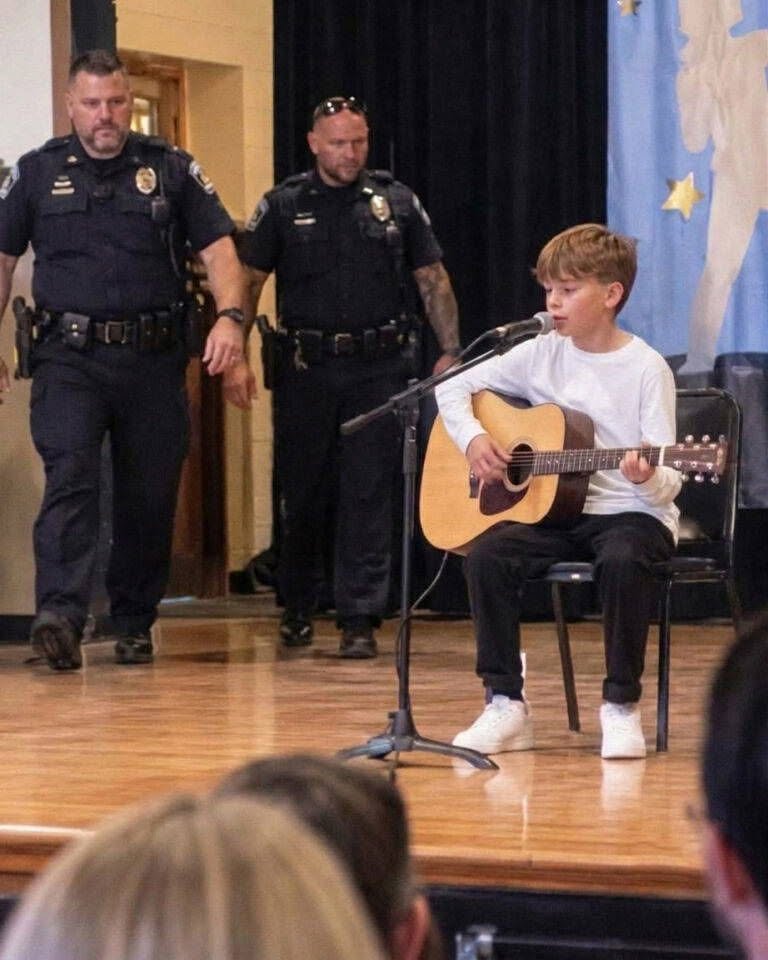
He climbed the steps with David’s guitar. His music teacher lowered the microphone to his height.
Beneath the gym lights, Caleb looked unusually small.
He scanned the audience until he found me.
For a moment, our eyes met.
Then he glanced toward the ceiling.
“This one’s for my dad,” he said.
He began playing.
I recognized the melody after three chords.
David used to sing it while making Saturday breakfast. He couldn’t cook quietly. If no music was playing, he sang himself.
Sometimes he’d deliberately change the lyrics until Caleb protested, “That’s not how it goes!”
Hearing that familiar tune again made my chest ache.
Caleb’s voice trembled through the first verse before growing steadier.
I covered my mouth as memories of David overwhelmed me. The grief I’d struggled to contain suddenly felt fresh again.
The woman beside me began crying, and a teacher across the aisle wiped her eyes.
Caleb was midway through the second verse when the gym’s double doors opened.
Two uniformed police officers entered.
Parents turned to look, including me.
My first thought was that something had happened.
One officer quietly spoke to a teacher near the entrance. She pointed toward Principal Bennett, standing along the side wall.
The officers started across the gym.